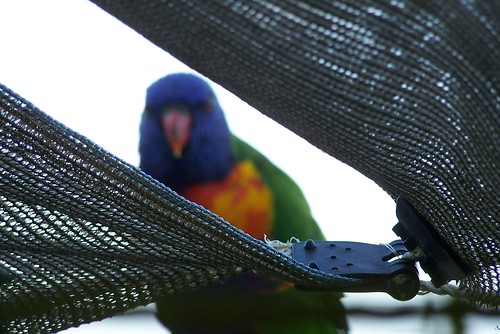
Showing posts with label birds. Show all posts

Tuesday, February 24, 2009

Never Mind the Pussy Cat

The Ornithological Art of Edward Lear:

In 1830, visitors to the new Zoological Gardens in London were bemused by a young man—a boy, really—who sat sketching the birds in the Parrot House. He drew the birds as they perched and played, and with the help of a zookeeper named Gosse, measured their wingspans, and the dimensions of their bodies, beaks, and legs. Visitors lingered to watch, and he filled the margins of his paper with caricatures of the people around him.

Edward Lear was working on a startlingly audacious project. Illustrations of the Family of Psittacidae, or Parrots was a monograph he planned to publish by subscription in fourteen folios. It was ground-breaking in several ways: Lear was the first ornithological illustrator to publish in the large folio size, and the first to devote an entire book to a single family of birds. His insistence on drawing from life whenever possible was innovative, as was his decision to use lithography.

Lear published the first two folios of the Psittacidae on November 1, 1830.


• Photo from Wiki Commons. Click on photo for very large image.

• Hat tip, Monkey Filter.


Digg!

Read More...

Saturday, March 15, 2008

Shoebill, or Whalehead

It's a bird.

SHOEBILL-head

And it's an Endangered Ugly thing. And I think I love it.

The Shoebill (Balaeniceps rex) is a large stork (maybe), whose beak quite closely resembles footwear associated with 19th century Dutch (compare). They inhabit central African wetlands, where they feed on lungfish, catfish, frogs, lizards, and the like. ARKive puts their hunting strategy quite succinctly: “Prey is grasped from the water in the bird's sharp, hooked beak, which grips, crushes and pierces in one instant.”


Digg!

Read More...

Thursday, April 26, 2007

Very Cool: FalcomCam

Via Metafilter: FalconCam:

Two peregrine falcon chicks hatched today (almost) live on downtown Indianapolis' FalconCam. Yay! They're very cute, but the parent sits on them a lot.


You can watch the big and tiny birds via cameras mounted in their nests and on a ledge nearby, refreshed every minute.

Read More...

Sunday, March 25, 2007

Blog in Australia

Excellent photos at this blog from the Northern Beaches.

I don't know if he has it on his blog (or on his other one - link to come), but this is a great video that he took of two lorikeets on his deck - with a mirror.


Read More...

Saturday, December 16, 2006

Laughing Kookaburra

The bird with the best name on the planet. The voice will be in my head forever.


Laughing Kookaburras are believed to pair for life. The nest is a bare chamber in a naturally occurring tree hollow or in a burrow excavated in an arboreal (tree-dwelling) termite mound. Both sexes share the incubation duties and both care for the young. Other Laughing Kookaburras, usually offspring of the previous one to two years, act as 'helpers' during the breeding season. Every bird in the group shares all parenting duties.


Actually saw one emerge from a termite nest on a tree once. Thought it was a little cream-colored rodent at first, then it flew off.


Read More...

Wednesday, December 6, 2006

Tawny Frogmouth

Walking through the suburbs of Sydney one night in October I heard this "ooo ooo ooo" sound:


Too dark to see, I pointed the camera at the sound and snapped:


I got lucky. It was a Tawny Frogmouth, probably about 16 inches from tip of the tail to head.

Here's a closer look:


More here. And more images of the messy-face Frogmouth here.

Read More...

Sunday, November 26, 2006

The Jesus Bird

From a recent trip to Australia and the Northern Territory: The Comb-crested Jacana, according to the very knowledgeable and perfectly-talkative guide on the South Alligator River in Kakadoo National Park (part of the Yellow Waters cruise), has the longest feet, per bird size, of any bird in the world. Allows in to "walk on water."


The Comb-crested Jacana [check out the illustrations circa 1800 by John Gould], also known as the Lotusbird, has a red fleshy forehead comb, a black crown, back and breast and brown wings. The belly, face and throat are white, and there is a faint yellow tinge around the eye and throat. Both sexes are similar in appearance, but the female is larger than the male, and slightly brighter in colour.

At a distance, the Comb-crested Jacana appears to have the ability to walk on water. In fact, it is walking on floating plants. Its extremely long toes help it to spread its body weight over a larger area. In flight, the long legs and toes trail behind the body.


Read More...